The In-Between Journal
 by Kenncofficial, Nov. 13th. 2025
The Liminal Space
There is a room with no corners. Light arrives like a question and the floor answers in code. In that room I learn to move without choosing a form. I paint with loops and uncomment my feelings with semicolons. Fabric folds like a function; a hem is a conditional that decides whether a body steps forward or dissolves back into shadow. The In-Between is not an aesthetic shorthand , it is a practice: a discipline of edges, a choreography of fractures where one medium borrows the grammar of another and something new is born.
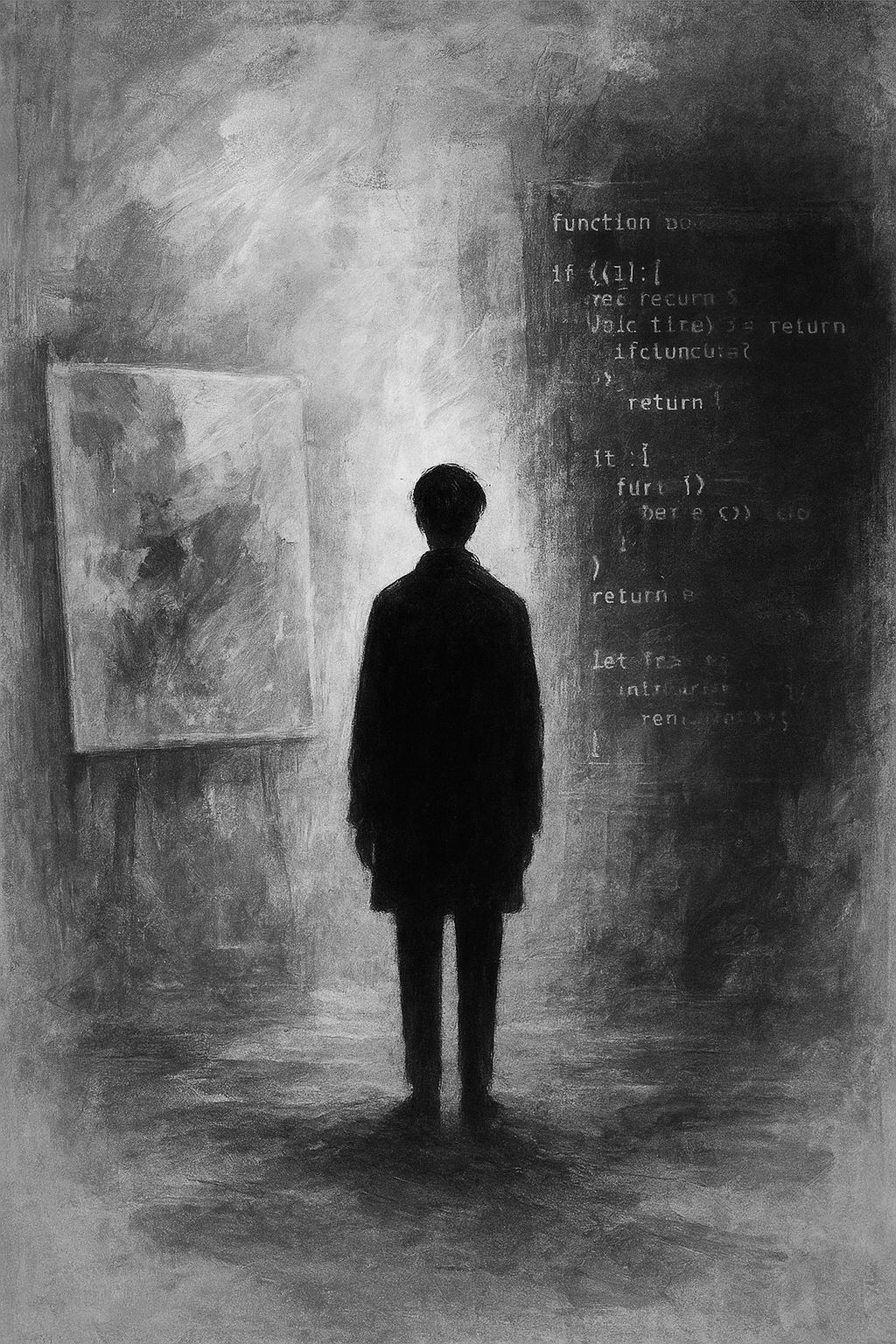
Step in. Leave certainty at the threshold. What you will read here are not polished theorems nor the tidy confessions of an artist who knows their position. These are field notes: impressions taken on the back of a receipt, sketches in the margin of an API spec, the residue of a thought after a fitting is done. They are attempts to measure textures that don’t want to be measured.
____________
1. The Collapse of Mediums
Imagine syntax as a brushstroke. Imagine color rendered with a shader rather than pigment. Imagine a garment that compiles while you wear it.
The collapse of mediums is not metaphor alone , it is a method for discovering what insists on existing when categories dissolve.
When I write a function I am composing a silhouette; when I cut cloth I am debugging an attitude.
The same tension surfaces whether I’m scoping a component or selecting a palette: Which rules do we follow? Which do we invent?
This collapse asks hard questions: "How does an algorithm inherit the dignity of a hand-made seam?" "When fashion borrows the logic of software, does it gain precision at the expense of breath?"
The answers are uneven and necessary. In practice, the overlap becomes a laboratory where failure is not an accident but an experiment. A failed render reveals how light wants to live on a surface.
A botched pattern reveals how a body resists a line.
There’s politics here, too. To blur disciplines is to redistribute authority. The engineer learns tactility; the tailor learns systems thinking. Each discipline loses monopoly on what counts as knowledge.
That redistribution is not neutral , it changes what we value and who gets to make rules.
"To create in the in-between is to translate what cannot be said , turning emotion into architecture, and architecture back into feeling."
2. Translation, Not Mastery
Mastery is a pleasant lie we tell ourselves to avoid risk. Translation is humbler and harder.
I do not seek to be the best coder or the best stylist; I seek to carry a truth from one language to another without killing its voice.
Translation preserves dissonance.
It allows a pixel to keep its grain and a stitch to keep its memory.
To translate is to accept the residue , the wobble that remains after transfer.
When I render a felt memory into UI, some of its heat will be lost; what arrives on the screen will be an echo.
The craft is to choose which echoes matter. Which friction enhances meaning? Which compromise becomes invention?
Translation also demands a politics of care. It asks: who benefits when we move ideas between systems?
When fashion becomes tech, who gets paid for the code that stitches the narrative together?
When algorithms borrow poetic forms, who owns the lineage of feeling?
The practice of translation must therefore be ethical, not ornamental.
It must reckon with lineage, labor, and authorship every time it crosses a boundary.
____________
3. Silence, Code, and the Human Thread
There are moments when a line of code is the quietest thing in the room. Not because it is empty, but because it holds a space , the way a pause in speech holds the next sentence like a secret.
Silence in creation is not an absence; it is the most honest medium we have. It makes architecture for meaning.
In the space between keystrokes and fabric, the human thread is what ties everything together. It is the impulse to make something that others can inhabit. Whether we write a homepage or tailor a coat, we are building thresholds for people to cross. That responsibility is not technical , it is ethical and intimate. Design without generosity fractures. Code without tenderness becomes coercion.
So I build systems that listen. I write interfaces that breathe. I construct runways that allow vulnerability as an acceptable mode of display. The human thread resists reduction: it does not want to be optimized into pure efficiency. It wants to be recognized in the delay, the irregularity, the laugh that breaks a rehearsal.
____________
4. Rites of the In-Between
Creation, for me, doesn’t begin with an idea, it begins with an encounter, a fragment that refuses to stay silent. A loose thread, a broken line of code, a memory that stutters. I don’t chase concepts, I let objects interrupt me. They carry a gravity ideas never do.
I work sideways, not upward. I test thoughts across mediums before I let them settle in one. A fold in fabric can correct a layout error. A glitch in code can teach me something about asymmetry in design. Nothing lives alone, every form is a rehearsal for another.
I keep a quiet archive of remnants, failed sketches, abandoned commits, phrases that arrived at the wrong time. They are seeds, not mistakes. Creation rarely grows from intention, it grows from residue.
Constraint is my collaborator, not the harsh kind imposed by scarcity, but the useful kind that forces invention. A single shade of light. A limited grid. A fabric that resists the body. Constraint reveals what abundance hides, the discipline of choice.
And above all, I make the labor visible to myself. I track the tremble before the breakthrough, the nights I almost quit, the moment a pattern finally aligned. Not because I need proof, but because creation deserves witnesses, even if the only witness is me.
These are not methods,
they are rites,
the quiet rituals that shape how I move through the in-between.
____________
5. Closing Reflection , Becoming the In-Between
There is a temptation to market the in-between as brand: edgy, post-disciplinary, Instagrammable.
Ignore that temptation. The in-between is not a look; it is an ongoing translation practice that is stubbornly unprofitable at first and impossible to fake.
It wants time, iteration, and honesty. It requires us to be apprentices to surprise.
If you stay, you will find that living between forms teaches a particular humility: the humility to be undone by another language, the courage to return and try again.
This is how new forms get made , not by stealing from a single lineage, but by allowing multiple lineages to argue in the same room until a pattern emerges that none of them could have predicted alone.
So read these notes like a map that is still being drawn. Walk into that room with no corners. Bring patience. Bring curiosity. Bring the willingness to be both precise and porous. The In-Between will change the way you measure beauty.
It will teach you that creation is less about control and more about choreography , of attention, of materials, of tech, and of the brief, human pauses that make meaning possible.